


Photoshop’s Remove Tool can now automatically detect and remove people, wires, reflections, and general distractions — including vehicles, poles, and street clutter — in a single click. Here’s how every method works, updated for Photoshop 2026.
| Tool | Remove Tool (J) — nested under the Spot Healing Brush |
| Find Distractions | 3 categories: People, Wires & Cables, General Distractions (new in 2026) |
| Requirements | Photoshop v26.5+ for People & Wires. v27.6+ for General Distractions. GPU acceleration recommended. |
| Generative AI | Optional — improves results on large or complex removals. Requires internet + Firefly credits. |
| Non-Destructive | Yes — work on a new empty layer with Sample All Layers enabled |
| Limitations | General Distractions does not remove people (use the People option for those). May struggle with very complex overlapping elements. |
What’s changed in Photoshop’s distraction removal — 2026 update
Photoshop’s AI-powered distraction removal has evolved significantly since this article was first published in 2025. The original covered People removal and manual reflection handling — but two major updates have since landed that change how the tool works and what it can do.
The biggest addition is General Distractions, which arrived in Photoshop beta v27.6 in March 2026 and moved to the stable release shortly after. Where the original Find Distractions feature only offered two specific categories (People and Wires & Cables), General Distractions uses a broader AI model to detect and offer targeted removal of poles, vehicles, trash cans, signs, stray animals, and other common scene clutter — across 26 different categories — with colour-coded overlays so you can see exactly what will be removed before committing.
Reflection removal also received a significant upgrade in the same update cycle, moving out of Camera Raw Filter exclusivity and into the main Photoshop interface directly. This makes reflection cleanup accessible without the Camera Raw detour the original workflow required.
This revamp covers all three Find Distractions categories in full, the updated reflection removal workflow, and a troubleshooting section covering the most common failure points including the ‘service not working’ error that affected General Distractions for some users in early 2026.
| 🆕 New in 2026: General Distractions (launched March 2026, stable release) is the most significant addition. It can automatically scan an image and categorise unwanted elements across 26 types — then let you toggle each category on or off before removal. This is fundamentally different from the original tool, which required you to know what you were removing before you started. |
What You’ll Need
- Latest Version of Adobe Photoshop
- A sample image (e.g., an urban event scene with a person, their shadow, and a reflective sign)
Setup: Non-Destructive Workflow First
Before using any distraction removal method, set up a non-destructive layer structure. This is the single most important habit — it lets you compare before and after, reduce the effect, or discard the removal entirely without touching the original pixels.
- Open your photo in Photoshop.
- Create a new empty layer above the Background: Cmd/Ctrl+Shift+N. Name it ‘Flawless Removal’.
- Select the Remove Tool (press J — if you get the Spot Healing Brush, press Shift+J to cycle to the Remove Tool).
- In the Options Bar, enable ‘Sample All Layers’. This lets the Remove Tool on your empty layer reference the pixel content of the Background layer below it.
| 💡 Pro Tip: Confirm ‘Sample All Layers’ is checked every session — it resets to unchecked when you restart Photoshop in some versions. If your removal layer looks blank or the tool seems to do nothing, this setting is almost always the cause. |
FIND DISTRACTIONS: WIRES & CABLES: One-click wire and cable removal
Best for: overhead power lines, cable clutter, antenna wires in landscape and urban photography
Wires and Cables is the most reliable of the three Find Distractions options — because wires are visually consistent and structurally simple (thin, linear, high-contrast against sky or backgrounds), the AI model detects them with high accuracy and the fill results are typically very clean on the first pass.
Step 1: Select Wires and Cables
With the Remove Tool active, click Find Distractions > Wires and Cables. Unlike the People option, Wires removal does not show a preview overlay before applying — it detects and removes immediately. The process takes 5–15 seconds.
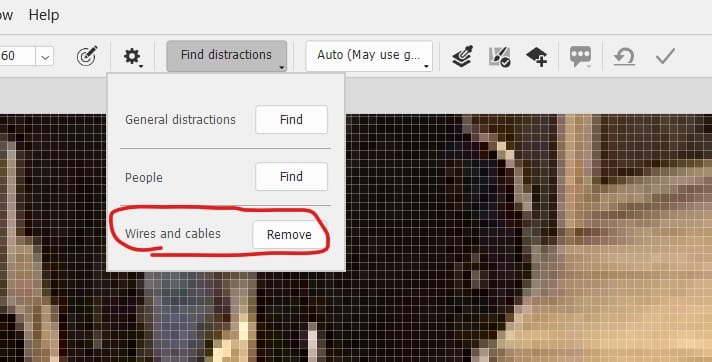
| 📌 Note: The Wires option also removes the wire itself but does not eliminate the shadow cast by the wire. If your image has visible wire shadows on walls or surfaces below the wire, you’ll need to manually paint over those shadow areas with the Remove Tool after the automatic wire removal is complete. |
Step 2: Handle Wire Shadows Manually
After automatic wire removal, zoom to 100% and scan the image for any remaining wire shadows — dark linear streaks on walls, rooftops, or ground surfaces beneath where the wire ran. These are common on sun-lit shots where the wire was casting a strong shadow.
Use the Remove Tool with a brush sized 10–20px (just wider than the shadow width). Paint along the shadow in short overlapping strokes — don’t try to cover the whole shadow length in one drag. Short passes give the AI better context from adjacent clean areas.
FIND DISTRACTIONS: GENERAL DISTRACTIONS
Best for: poles, street signs, parked vehicles, trash bins, street furniture, and mixed scene clutter
| 🆕 New in 2026: General Distractions launched in Photoshop beta v27.6 (March 2026) and moved to stable release in May 2026. It is the most powerful addition to the Remove Tool since its introduction — it replaces the need to know what you’re removing before you start, letting the AI identify and categorise everything in the scene first. |
Unlike People and Wires, which look for specific predefined element types, General Distractions uses a broader scene-understanding model to detect anything that reads as an unwanted element — across 26 categories including poles, vehicles, street signs, barriers, trash receptacles, street furniture, temporary structures, and stray animals.
The key difference in the workflow: General Distractions presents a colour-coded panel showing everything it found, categorised, with checkboxes to include or exclude each category before any removal happens. This gives you editorial control over what gets removed that the other two methods don’t offer.
Step 1: Run the General Distractions Scan
With the Remove Tool active, click Find Distractions > General Distractions, then click Find. Photoshop analyses the entire image — this scan takes longer than People or Wires detection, typically 10–30 seconds, and requires a stable internet connection if the Generative AI model is active.
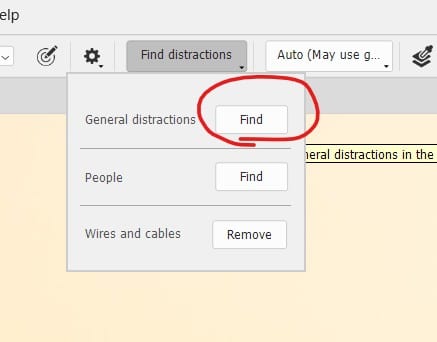
When complete, a panel appears listing every detected distraction category with a count (e.g., ‘Poles: 3’, ‘Vehicles: 1’, ‘Street Signs: 2’). Each category is assigned a different highlight colour on the canvas, and you can see all detected elements highlighted simultaneously.
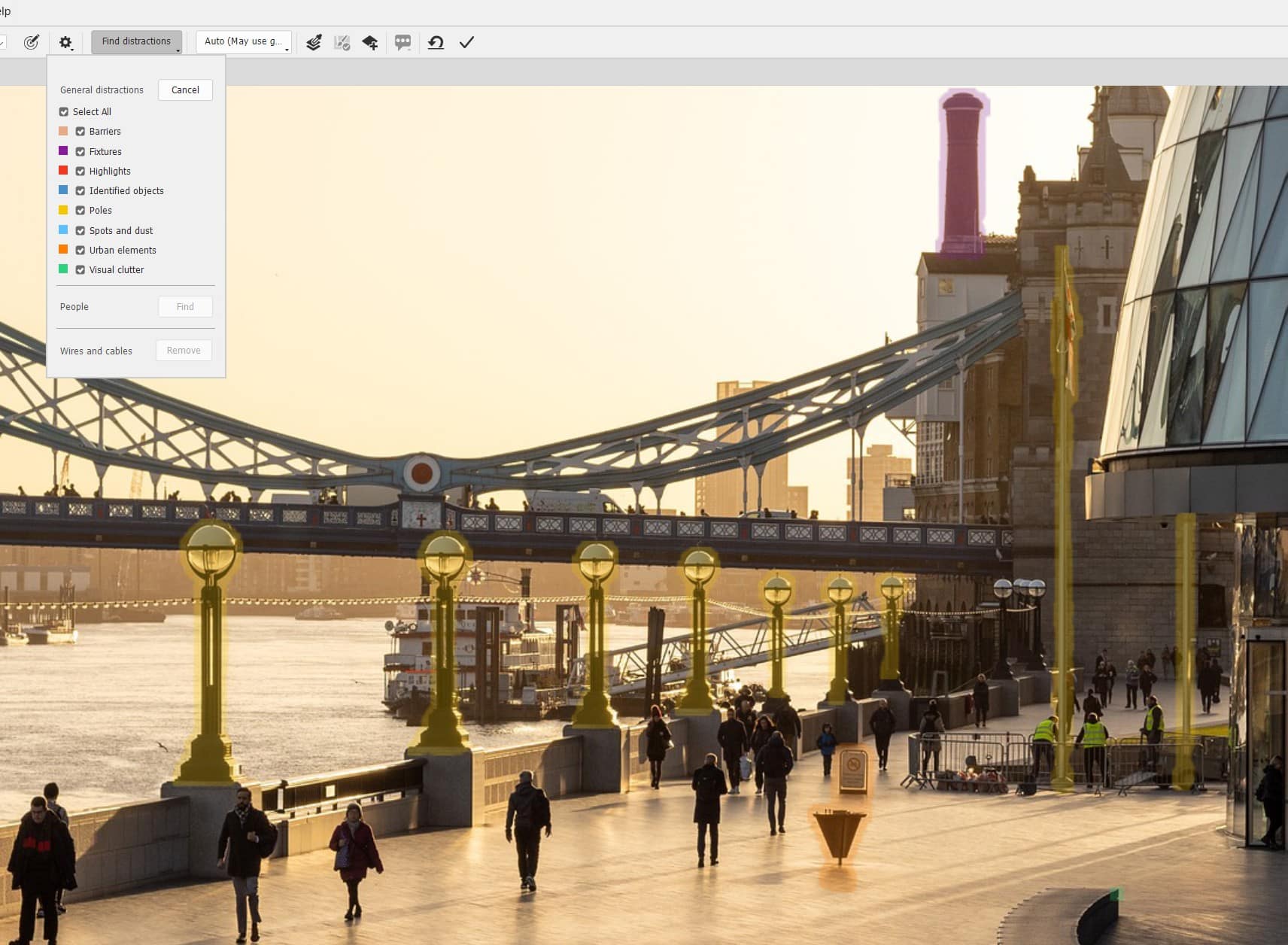
| 💡 Pro Tip: Click any colour swatch in the General Distractions panel to change that category’s highlight colour. This is useful when two similar-coloured categories overlap and you need to distinguish them visually before committing to removal. |
Step 2: Select and Deselect Categories
Use the checkboxes in the panel to choose which categories to remove. Uncheck anything you want to keep — for example, if a red phone box is categorised as a ‘Street Furniture’ distraction but you want it in the shot, uncheck that category. The canvas overlay updates to reflect your choices in real time.
For individual items within a category that you want to keep — say, one of three detected poles — hold Alt/Opt and paint over its overlay on the canvas to deselect that specific element while keeping the rest of the category checked.
| ⚠ Watch Out: General Distractions does not detect or remove people — the People category is excluded from its detection model. If your scene has both people and general distractions to remove, run People removal first, then run General Distractions as a second pass. Running them in the opposite order can cause the fill from the people removal to be detected as a new distraction. |
Step 3: Apply and Refine
Click Apply (or the checkmark in the Options Bar) to remove all checked categories simultaneously. Photoshop processes each category’s elements and fills the gaps. For complex scenes with multiple overlapping removals, this step may take 20–60 seconds.
Review the result at 100% zoom. General Distractions typically produces clean results on isolated elements with clear background behind them. Elements that overlap with other kept elements (a sign partially behind a building, a pole partially obscured by a tree) are more likely to need a manual touch-up pass.
Reflection Removal — Updated 2026 Workflow
Reflection removal was significantly updated in May 2026. It’s no longer only available inside the Camera Raw Filter — it’s now accessible directly in the main Photoshop interface, making the workflow considerably faster.
Step 1: Access Reflection Removal
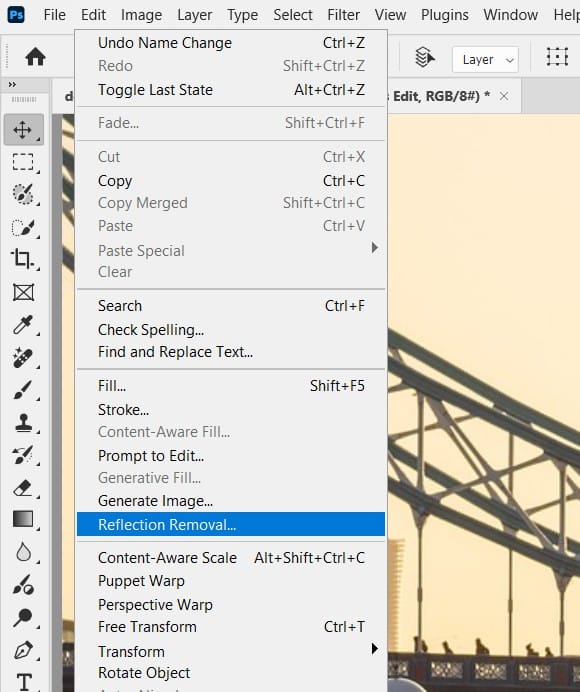
Go to Edit > Reflection Removal (this is the new direct path added in 2026). Alternatively, it remains available inside Filter > Camera Raw Filter > Optics panel if you prefer that workflow. Both produce the same result — the direct Filter menu path is simply faster for images that don’t need Camera Raw processing.
Step 2: Apply and Adjust
The Reflection Removal dialogue shows a before/after split preview. The Amount slider (0–100%) controls how aggressively the AI suppresses the reflection. For most situations:
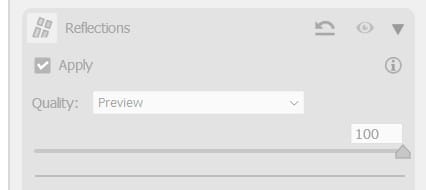
- Window reflections on urban photographs: 60–80%
- Light glare on glass surfaces: 70–90%
- Subtle reflection on water or wet surfaces: 30–50%
Final Results
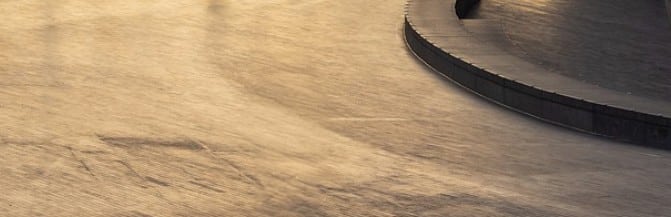
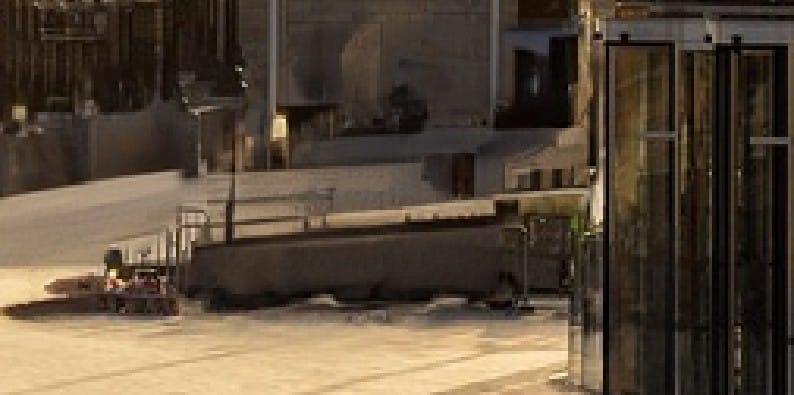
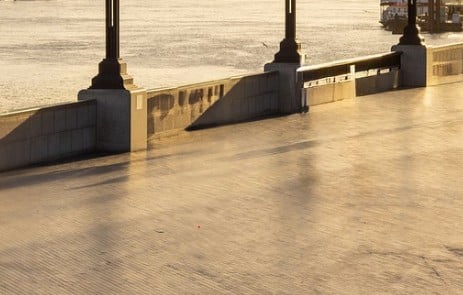
This is the result I have after performing various distraction removals:
What Each Distraction Category Removes
| Category | What It Detects | Best Used On |
| People | Human figures and their cast shadows | Event photography, street scenes, portraits with bystanders |
| Wires & Cables | Power lines, cables, antenna wires | Landscape, architecture, urban skyline shots |
| General Distractions | Poles, vehicles, signs, bins, street furniture, barriers, stray animals (26 categories) | Complex urban/street scenes with mixed clutter |
| Reflections (separate filter) | Window reflections, glass glare, surface reflections | Architecture, product photography, interior shots |
Generative AI Mode — When to Use It
The Remove Tool offers a choice between Content-Aware processing (local, no internet, no credits) and Generative AI processing (cloud-based, uses Firefly credits, better results on complex areas). In Photoshop 2026 the Mode dropdown is in the Options Bar.
- Content-Aware (Mode: Off): no internet required, no credit cost, fast. Best for simple backgrounds — sky, grass, plain walls, repetitive textures. This is the correct choice for most wire removal and people removal against clean backgrounds.
- Generative AI (Mode: On or Auto): cloud processing via Adobe Firefly, uses generative credits from your CC plan, slower (3–10 seconds per area). Significantly better results on complex backgrounds — busy street scenes, architectural detail, mixed textures. Use this when Content-Aware leaves visible artefacts.
- Auto: Photoshop decides which mode to use based on the complexity of the fill area. A reliable choice for most situations — it defaults to Content-Aware where that’s sufficient and escalates to Generative AI when the background is too complex for local processing.
| 💡 Pro Tip: Check your Creative Cloud generative credits before a heavy editing session using Find Distractions with Generative AI on. Each fill area consumes credits proportionally to its pixel size. For a typical session removing people from a single urban photo, the credit cost is minimal — but running General Distractions on a complex scene with 20+ elements in Generative AI mode can consume a meaningful portion of a monthly allowance. |
Troubleshooting — Common Problems and Fixes
| Problem | Cause | Fix |
| ‘Couldn’t find any general distractions in the image’ | GPU acceleration off, or image type not supported by the model | Enable GPU in Preferences > Performance. Also try on a different image — the General Distractions model works better on outdoor scenes than interior or studio shots. |
| ‘The service is not working’ error on General Distractions | Cloud service outage or internet connectivity issue | Check Adobe’s status page (status.adobe.com). This error affected users intermittently in early 2026 — Adobe resolved the underlying issue in April 2026. If it persists, switch to Content-Aware mode. |
| Remove Tool appears to do nothing on the working layer | Sample All Layers not enabled | In the Options Bar, confirm ‘Sample All Layers’ is checked. Without this, the Remove Tool on an empty layer has no pixels to sample from. |
| People removal leaves a ghost outline of the removed figure | Background is too complex for Content-Aware fill to reconstruct cleanly | Switch Mode to Generative AI and repaint over the ghosted area. For very complex backgrounds, break the removal into smaller brush strokes rather than painting the whole figure at once. |
| General Distractions is removing elements I want to keep | AI categorised a wanted element as a distraction | Uncheck that category in the panel, or hold Alt/Opt and paint over the specific element’s overlay on the canvas to exclude it from removal. |
| Reflection Removal is not in my Filter menu | Running Photoshop version before May 2026 update | Update to the latest stable Photoshop via Creative Cloud. Filter > Reflection Removal was added in the May 2026 stable release. Earlier versions must use Filter > Camera Raw Filter > Optics panel instead. |
| Wire removal left visible shadow streaks | Wire shadows are not removed by the Wires & Cables auto-detection | Manually paint over wire shadows with the Remove Tool brush at 10–20px after the automatic removal completes. |
Why This Rocks
The “Find Distractions” upgrade makes Photoshop’s AI a flawless distraction-busting beast, handling shadows and reflections that 2024’s version struggled with. It’s a time-saver for urban or event photographers aiming for perfection. Try it on your next cluttered shot, or check out other AI related tutorial here on PSD Vault!