


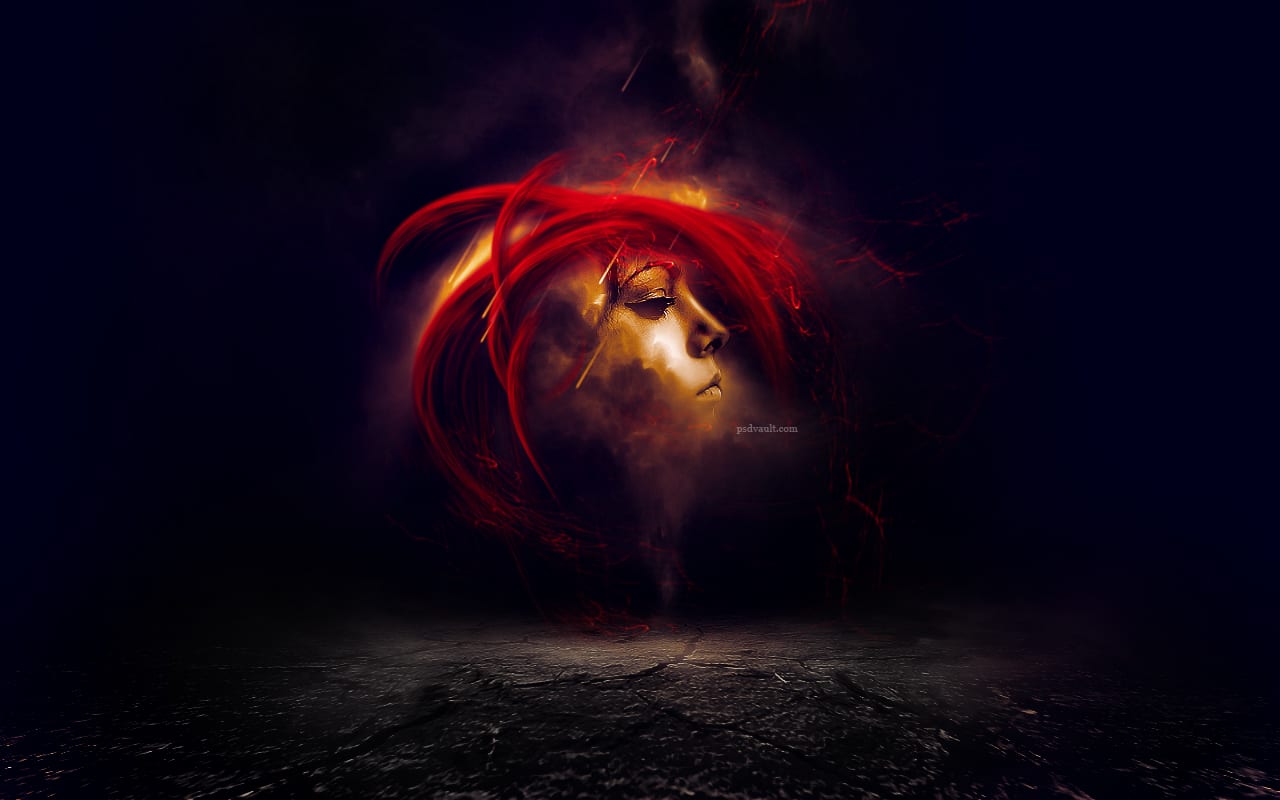
This photo manipulation tutorial walks you through creating a dramatic floating face effect with swirling fiery hair — combining portrait extraction, fire texture compositing, and the Twirl filter to build a surreal, atmospheric piece that showcases some of Photoshop’s most satisfying compositing techniques.
I originally created this effect back in 2012, and it remains one of the most visited tutorials on PSDVault. The core technique — using the Twirl filter on fire textures to simulate flowing hair — is just as effective in Photoshop 2025 as it was then, and the result still turns heads.
A quick note on stock images: the three stock image links in the original tutorial (two from DeviantArt, one from CGTextures) are no longer active — both sites have either removed the files or restructured their URLs since 2012. For this updated version, use the following free replacements instead:
- Ground texture: Unsplash.com — search “cracked ground texture” or “dry earth texture”. Look for a shot with strong perspective depth and earthy tones.
- Face/model: Unsplash.com — search “woman portrait neutral expression”. Choose a front-facing or slight three-quarter shot with clean, even lighting and a plain background for easier extraction.
- Fire texture: Unsplash.com — search “fire flame black background”. You need a fire photograph shot against a near-black background — this is essential for the Screen blend mode technique in Steps 4 and 5 to work correctly.
All three are free to use with attribution under Unsplash’s licence. Download all three before starting and keep them open as separate Photoshop tabs — it makes switching between source images much faster than going back and forth to your desktop.
The PSD file for this tutorial is available to PSD Vault VIP members — useful if you want to inspect the layer structure and exact adjustment layer settings before following along yourself.
Let’s get started.
Here is a preview of the final effect I have for this tutorial: (click to enlarge)
PSD Vault VIP Membership
You can download the PSD File for this tutorial via the VIP Members Area for only $6.95/Month (or less)! You will not only get this PSD File, but also 250+ other PSD Files + Extra Goodies + Exclusive Photoshop tutorials there. Signup now and get exclusive!
Step 1
Create a new document sized 1280 * 800px with black background. Load the ground image into Photoshop and select a piece from the ground, copy and paste the selection onto the image, then perspective it as shown below:

Use a soft eraser to fade the top edge as shown below:

Add the following 3 adjustment layers on the ground layers:
Black and White

Levels

Layer mask on the levels adjustment layer:

Curves

and you will have the following effect so far:

Step 2
Use Select > Subject to make an initial selection of the face, then refine the edges in Select > Select and Mask. For the neck and jaw edge, use the Refine Edge Brush at 5–10px to get a clean transition. Apply as a Layer Mask rather than erasing directly — this keeps the extraction non-destructive.

Copy and paste the selection into our document, use a small soft eraser to clean up the edge:

Then we want to erase part of her face with a soft eraser:

Step 3
Add the following 3 adjustment layers as clipping mask to this face layer:
Black and White

Levels

Curves

Layer mask on the curves adjustment layer:

and here is the effect so far:

Step 4
We can add some cloud behind and around the face area with the cloud filter or a cloud brush:

We will now add fire texture into the image – select a piece as shown below:

Warp this selection and aim to achieve this shape below:

Apply the following image adjustments to this fire texture layer:


and here is the effect so far:

Go to Filter > Distort > Twirl and apply the following settings:

Hit Ctrl + F and repeat this filter a few times, and you will have the following effect:

Tip: Before applying the Twirl filter, make sure the fire texture layer is selected (not a mask or adjustment layer). Go to Filter > Distort > Twirl. Start with Angle set to 200–250°. Press Ctrl/Cmd+F to repeat the filter – each repetition increases the spiral. 3–4 repeats typically gives the hair-like swirl effect. If the twirl looks too centred, use Free Transform to reposition the fire texture before applying so the swirl originates from above the head rather than the centre of the canvas.
Duplicate this layer few times and merge them together, then duplicate the merge layers a few times and scatter them around the head:

Step 5
We’re almost done! For some final touches, I added some particles with this rain brush I created on the image:

I then added some fire particles by going back to the fire image and selecting parts of it, copy and paste the selection onto our image:
Hint: make sure you change the blending mode of these fire layers to “Screen”.


For the final colour grade, I used two adjustment layers at the top of the layer stack. A Selective Color adjustment targeting the Reds — pushing Cyan -15, Yellow +10 — to warm the fire tones. Then a Curves adjustment with a gentle S-curve for overall contrast, plus a slight boost to the Red channel midpoint (Input 128, Output 138) to push the warm amber colour across the whole composition.

Tips and Tricks You May Find Useful for this Photo Effect
Tip 1 — Use Screen blend mode on all fire layers, not just the final particles.
Every fire texture layer in this composition should use Screen blend mode. Screen makes the dark/black areas of the fire image completely transparent, leaving only the glowing flame visible. If you leave any fire layer on Normal mode, you’ll see an ugly rectangular box around the flame. Apply Screen as soon as you paste each fire selection.
Tip 2 — Vary your Twirl repetitions for different hair strands.
Don’t apply the same number of Twirl repeats to every duplicated fire layer. 3 repeats gives a loose wave, 5 gives a tighter curl, 7+ gives a very tight spiral. Mixing different amounts across your duplicated layers creates a more natural, varied hair texture rather than obviously repeated copies of the same shape.
Tip 3 — Use Warp more aggressively than you think.
The key to making fire look like flowing hair is in the Warp step before the Twirl. In Free Transform, right-click > Warp and spend time pulling the mesh handles to create an elongated, tapering shape — wide at the scalp, narrowing to a point at the tip. The more hair-like your warp shape before the Twirl, the more convincing the result after it.
Tip 4 — Add a Hue/Saturation clipping mask to individual fire layers to vary colour.
Real hair isn’t one uniform colour — it has variation. Add a Hue/Saturation adjustment as a clipping mask to individual fire layers and shift the Hue slightly between them (±10–15 on the Hue slider). Some strands will read as deeper orange, others as brighter yellow, which adds convincing variation to the fiery hair without any additional compositing work.
Tip 5 — Try Generative Fill for the cloud/atmosphere (Photoshop 2024+).
Instead of using the Render Clouds filter or a cloud brush for the atmospheric background, make a loose Lasso selection behind the face area and use Generative Fill with the prompt “dark atmospheric smoke and mist, fantasy art style”. The AI-generated result typically integrates more naturally with the fire and face elements than the procedural Cloud filter, and gives you three variations to choose from.
That’s it for this tutorial! Hope you enjoy it and find it useful! Till next time, have a great day!
11 Comments
Great useful tutorial. Your post is very much helpful for the designer. Very easy to follow step by step. I like your post very much. Thanks a lot for sharing !!
Great useful tutorial. Your post is very much helpful for the designer. Very easy to follow step by step. I like your post very much. Thanks a lot for sharing !!
Hi there, basically all you need to do is to change the blending mode of that light dot layer to “overlay”, instead of normal, then apply the twirl filter and so on.
Hope this helps :)
I’m sorry but I found the tutorial difficult to follow and poorly written.
wow! what a charm full tutorial.
could you explain the last part where you added some colours and adjusted and adjusted the contrast and curves?
not so easy steps but explanation made them easy
Thanks for tuts, followed your adwise but added my own spice to it, awsome…..
can u upload a whole video tutorials ?
Thank you, but the tutorial is not an easy to follow at all, there are very few details of how you did things
The Ground image link is broken. Please upload another linkR